
College Basketball Tennessee Volunteers
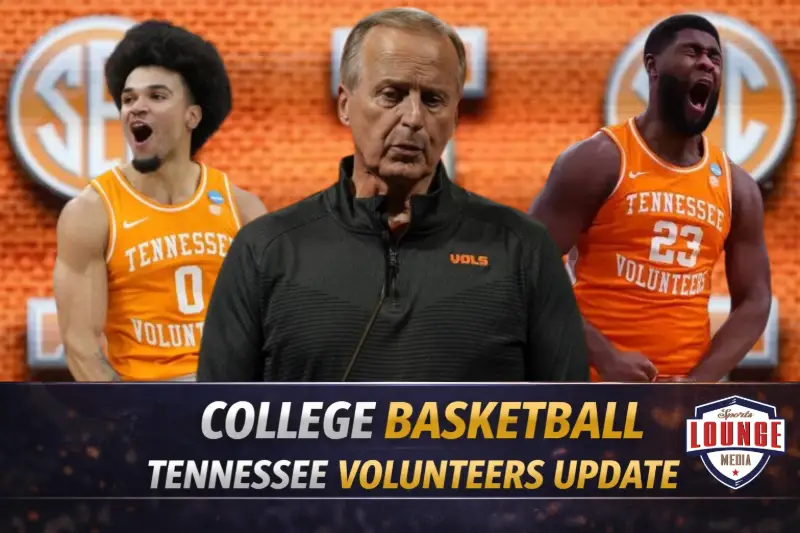
There are offseasons and then there is this. What's unfolding around the Tennessee Volunteers men's basketball program isn't just roster turnover. It's not a rebuild in the traditional sense. It's something far more rare, far more uncertain, and perhaps far more revealing about the modern state of college basketball.
As things stand, Tennessee is staring at the possibility of entering an upcoming season with no returning players on the roster. Zero. No continuity. No veterans. No familiar faces. Just an empty locker room and a coaching staff tasked with building an entire team from scratch in real time.
Welcome to the new reality of college hoops.
The Vanishing Roster
Roster turnover isn't new. Every program deals with graduation, transfers, and the occasional early NBA departure. But what Tennessee is experiencing goes beyond normal attrition.
Between the explosion of the transfer portal, NIL opportunities, and shifting player priorities, the Volunteers have seen a complete exodus. Players leaving for bigger roles, better fits, or more lucrative opportunities has become the norm across the sport but rarely does it leave a program completely stripped.
This isn't just losing starters. This is losing everyone.
For a program that has been defined by consistency, physicality, and defensive identity under Rick Barnes, the situation raises a fundamental question:
What is Tennessee basketball without its players?
The Transfer Portal Era: A Double-Edged Sword
The same system that emptied Tennessee's roster is also the one that could rebuild it overnight.
The transfer portal has turned college basketball into something closer to free agency. Coaches are no longer just recruiting high school prospects, they're assembling rosters like general managers.
For Tennessee, that means opportunity.
Instead of developing players over multiple years, the Vols can now:
- Target experienced college players
- Fill immediate positional needs
- Add scoring, shooting, or size on demand
- Rebuild faster than ever before
But there's a catch.
Chemistry can't be recruited as easily as talent.
Building a Team vs. Buying a Roster
There's a difference between assembling a collection of players and building a team and that distinction will define Tennessee's season.
Programs that rely heavily on transfers often face early struggles:
- Defensive rotations take time to learn
- Offensive systems require cohesion
- Leadership must emerge organically
Under Rick Barnes, Tennessee has traditionally thrived on:
- Elite defense
- Toughness
- Player development
- Veteran leadership
Those qualities don't automatically come with a brand-new roster.
The challenge isn't just replacing players, it's replacing identity.
The Recruiting Balancing Act
Tennessee now finds itself navigating three critical pipelines simultaneously:
1. Transfer Portal
This is the fastest way to rebuild. Expect Tennessee to aggressively pursue experienced players who can contribute immediately.
2. High School Recruits
While transfers dominate headlines, long-term stability still depends on developing young talent.
3. NIL Strategy
In today's game, NIL is no longer optional, it's essential. Competitive programs must align resources to attract and retain players.
The Vols aren't just competing on the court, they're competing in a marketplace.
Pressure on the Sideline
Few coaches are better equipped for this challenge than Rick Barnes. With decades of experience and a reputation for building disciplined, defensive-minded teams, he provides stability in an otherwise chaotic moment.
But this situation tests even the most seasoned coaches.
Barnes must:
- Recruit an entire roster in months
- Establish a culture with new personalities
- Implement systems quickly
- Manage expectations in a volatile environment
And all of it must happen before the first game tips off.
The SEC Isn't Waiting
If Tennessee were rebuilding in a weaker conference, there might be room for error. But the Southeastern Conference is one of the most competitive leagues in college basketball.
Programs like Kentucky, Alabama, and Arkansas aren't slowing down.
They're reloading, not rebuilding.
For Tennessee, that means there's little margin for a slow start. A team built entirely from new pieces will have to find rhythm quickly or risk falling behind in a brutal conference race.
A Blank Slate And a Rare Opportunity
For all the uncertainty, there's also something intriguing about Tennessee's situation.
A completely empty roster means:
- No lingering bad habits
- No positional logjams
- No expectations tied to returning players
It's a true reset.
Barnes and his staff have the rare chance to design a team exactly how they want:
- More shooting? They can prioritize it.
- More length? They can target it.
- Faster pace? They can build for it.
In many ways, this is college basketball's version of a franchise reboot.
What Success Looks Like
With such a dramatic reset, expectations must be recalibrated.
Success for Tennessee may not be measured solely in wins and losses, but in:
- How quickly the team gels
- Defensive identity taking shape
- Development of new leaders
- Competitive play within the SEC
If the Vols can become a cohesive unit by midseason, they could still be dangerous—especially in March.
Because in the NCAA Division I Men's Basketball Tournament, experience matters—but momentum can matter just as much.
The Bigger Picture: College Basketball's New Reality
Tennessee's situation isn't an anomaly, it's a warning sign.
What's happening in Knoxville reflects a broader shift in the sport:
- Player movement is constant
- Rosters are fluid
- Stability is rare
Programs that adapt will survive. Those that don't will fall behind.
The days of four-year players anchoring a program are fading. In their place is a faster, more volatile system where change is the only constant.
Final Thoughts
An empty roster is usually a sign of trouble.
But for Tennessee, it might also be a moment of transformation.
This isn't just about replacing players, it's about redefining what Tennessee basketball will look like in a new era of the sport.
Will the Vols struggle to find identity? Or will they emerge as a model for how to rebuild in the portal age?
One thing is certain:
When the season tips off, Tennessee won't just be playing games, they'll be writing one of the most fascinating stories in college basketball.