
NBA Frenzy Week: Surges, Seeding Battles, and Statement Wins
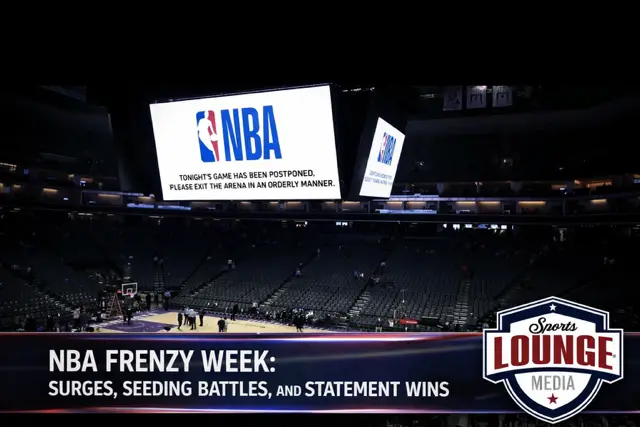
The NBA calendar has officially turned from routine to urgency.
With the regular season entering its final stretch, this past week offered a clear shift in tone across the league. Rotations tightened. Possessions carried more weight. What once felt like another checkpoint in an 82 game grind now resembles a preview of the intensity waiting in April and May.
Across both conferences, the story is no longer just about who is winning. It is about how teams are positioning themselves for what comes next.
Detroit Rises as the East Takes Shape
The headline out of the Eastern Conference is one few predicted at the start of the season.
Detroit sits atop the standings at 54 and 20, holding the number one seed as March closes. At this stage of the year, that is no longer a surprise. It is a statement.
The Pistons have built their identity on balance and discipline. Their lead guard controls tempo, their wings defend with consistency while stretching the floor, and their frontcourt brings a physical presence without slowing the pace. This is not a team riding momentum. It is a team that has learned how to win in different ways, night after night.
Right behind them, Boston continues to apply pressure. At 50 and 24, the Celtics have once again reached the 50 win mark, reinforcing their place among the league's most reliable contenders. Questions about depth and durability followed them into the season, but their structure has held. Offensively, they create mismatches with spacing and movement. Defensively, they remain capable of locking down opposing guards when fully engaged.
If Detroit represents the league's emerging force, Boston still carries the presence of a team that understands how to navigate deep postseason runs.
The rest of the conference is tightly packed. New York, Cleveland, Toronto, Atlanta, and Philadelphia are separated by only a handful of games, creating a volatile race where positioning could change overnight. Every matchup between these teams now carries playoff implications, from home court advantage to avoiding the unpredictability of the play in.
Further down the standings, Orlando, Miami, and Charlotte remain within striking distance. Each team is walking a narrow line, where a single strong week could secure a postseason spot, while a brief slump could end the season altogether.
Western Conference: Stability at the Top, Chaos in the Middle
Out West, the hierarchy at the top is more defined, but the competition beneath it is relentless.
Oklahoma City leads the conference at 58 and 16, with San Antonio close behind at 55 and 18. Both teams have already secured playoff spots and continue to perform with a level of consistency that reflects maturity beyond their years.
The Thunder rely on versatility. Multiple playmakers, length across every position, and an offensive system built on movement and spacing have made them difficult to defend. Their ability to maintain pressure for four quarters has separated them from much of the field.
San Antonio presents a different challenge. Built around a generational presence in the frontcourt, their system blends structure with flexibility. They protect the rim at an elite level while maintaining offensive fluidity, capable of adjusting tempo based on the matchup. What once felt like a long term project has accelerated into immediate contention.
Behind them, the race tightens.
The Lakers, Nuggets, Timberwolves, and Warriors are all competing for positioning, each bringing a different identity. Los Angeles leans on late game shot making. Denver continues to operate through one of the league's most efficient offensive hubs. Minnesota imposes its will with size and interior defense. Golden State, revitalized by roster adjustments, has reintroduced itself as a dangerous matchup no contender is eager to face.
The margin between hosting a playoff series and falling into the play in remains razor thin, making every game critical.
Offense Reaches Another Level
This week also reinforced a growing trend across the league.
Scoring is accelerating.
The combination of pace, spacing, and shooting has pushed offensive production to new heights. Teams are increasingly comfortable playing with five perimeter threats, forcing defenses into constant rotation and opening the floor in ways that were once uncommon.
The results have been striking.
A 157 to 137 game between Chicago and Philadelphia on March 25 stood out as one of the highest scoring performances of the season. That same night, Denver and Dallas combined for another high output contest, highlighting just how difficult it has become to sustain defensive consistency for extended stretches.
This is not simply a product of hot shooting nights. It reflects a broader evolution. Guards are extending their range well beyond the arc. Wings are attacking closeouts earlier in possessions. Frontcourt players are initiating offense rather than finishing it.
The modern game is asking defenses to solve more problems than ever before.
The question now is whether that balance shifts once the playoffs begin, when pace slows and possessions become more deliberate.
Health Becomes the Deciding Factor
At this stage of the season, availability may matter more than seeding.
Teams are navigating a difficult balance between maintaining momentum and protecting their most important players. A slight difference in standings can be overcome. A missing star in May cannot.
Boston's management of Jaylen Brown's Achilles soreness reflects that reality. There is little incentive to push through minor issues when the larger goal remains a deep postseason run.
Across the league, similar decisions are playing out. Minutes are being monitored. Rest days are becoming more strategic. Coaches are choosing long term health over short term results, even in tightly contested games.
For role players, this period creates opportunity. Injuries and rest open minutes, allowing younger or less established players to prove their value. Those performances can shape playoff rotations and influence how teams adjust once the stakes rise.
The Final Stretch
As April approaches, several key storylines will define the closing weeks of the season.
Detroit's ability to hold the top spot in the East will reshape expectations for the conference. Boston remains close enough to reclaim control, setting up a potential shift in hierarchy before the postseason begins.
In the West, the race between Oklahoma City and San Antonio carries implications beyond seeding. Securing the top position not only provides home court advantage, but also influences the path through a highly competitive bracket.
Perhaps most compelling is the cluster of teams in the middle of both conferences. Movement within that group can happen quickly, and each game now carries layered consequences that extend beyond a single result.
A Playoff Picture Taking Form
If this week offered any indication, the league is entering its most unpredictable phase.
New contenders have emerged. Established teams remain within reach. Offenses are producing at historic levels, while health concerns linger just beneath the surface.
The standings continue to shift, but one thing is clear.
The intensity has already arrived.
And when the postseason begins, it may deliver one of the most compelling playoff pictures in recent memory.