
Tennessee vs. Texas: Two States Built by Volunteers, One SEC Battle in Knoxville
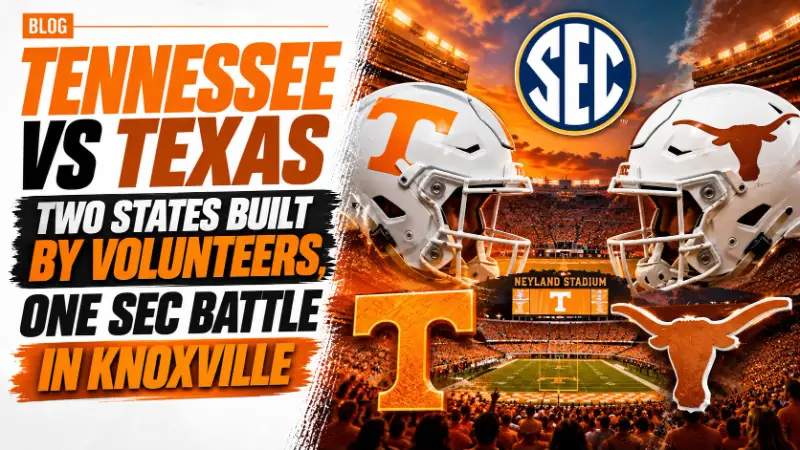
Saturday's showdown in Knoxville was all three.
The No. 14 Tennessee Volunteers welcomed the No. 1 Texas Longhorns into Neyland Stadium on September 26 for one of the most fascinating SEC matchups of the young 2026 season. When it was over, Texas escaped Rocky Top with a hard-fought 20-17 victory, improving to 4-0 while Tennessee fell to 3-1.
But Tennessee versus Texas is about much more than one Saturday afternoon. This was a meeting between two iconic programs, two massive fan bases and two states whose histories are connected in ways that make this matchup almost feel destined.
A Defensive War on Rocky Top
More than 101,000 fans packed Neyland Stadium for the first Tennessee-Texas football game ever played on either school's campus. The announced attendance was 101,915, Tennessee's 30th consecutive sellout. Before Saturday, every previous meeting between Tennessee and Texas had taken place hundreds of miles away in Dallas at the Cotton Bowl.
This time the Longhorns finally came to Rocky Top. And Tennessee made them work for everything.
Texas led 10-3 at halftime, but Tennessee refused to go away. The Volunteers' defense held the nation's No. 1 team to only 61 rushing yards, the fourth-lowest rushing total allowed by Tennessee during the Josh Heupel era. Texas also converted only three of its 12 third-down opportunities and managed 14 first downs.
The problem was what happened on the other side of the football. Texas' defense produced an incredible 10 sacks, the second-highest single-game total in Longhorn history.
Freshman quarterback Faizon Brandon battled through the pressure, completing 17 of 29 passes for 145 yards and a touchdown without throwing an interception. Mike Matthews provided Tennessee's biggest receiving threat, finishing with four catches for 72 yards.
With Texas leading 20-10 late in the fourth quarter, Tennessee mounted one final charge. Brandon connected with Matthews for a 30-yard touchdown with 1:27 remaining. Suddenly it was 20-17.
Then Neyland Stadium exploded.
Tennessee attempted an onside kick, Texas fumbled the recovery attempt and the Volunteers recovered the football with one final opportunity to complete a remarkable comeback. Tennessee had life. But Texas' pass rush again became the difference. The Volunteers couldn't finish the drive, and the Longhorns escaped Knoxville with the three-point victory.
Tennessee didn't get the upset. But Texas certainly knew it had been in a fight.
This Wasn't Just Another SEC Game
The most surprising fact about Tennessee and Texas is how rarely they have actually played. Saturday was only the fourth meeting in history between the Volunteers and Longhorns. It was also the first regular-season meeting between the schools and their first matchup as SEC opponents following Texas' move into the conference in 2024.
Before Saturday, Tennessee and Texas had not played since January 1, 1969. Their entire football history consisted of three Cotton Bowls. And those games featured some unforgettable moments.
1951 Cotton Bowl, Tennessee Strikes First
The series began on January 1, 1951. Tennessee entered the Cotton Bowl under legendary coach General Robert Neyland and defeated Texas 20-14. One of the signature moments came from Tennessee star Hank Lauricella, whose famous 75-yard run helped set up the Volunteers' first touchdown.
Texas eventually built a 14-7 halftime lead, but Tennessee controlled the second half. Andy Kozar scored twice on the ground as the Volunteers completed the comeback. Tennessee rushed for 295 yards that afternoon, with Lauricella producing 131 yards and Kozar adding 92. The Volunteers had officially introduced themselves to Texas football.
1953 Cotton Bowl, Texas Gets Revenge
Two years later, the schools returned to Dallas. This time Texas dominated. The Longhorns defeated Tennessee 16-0, holding the Volunteers to only 32 yards of total offense while Texas accumulated 301.
The game carried additional historical importance for Tennessee. It was the final game coached by Robert Neyland. Neyland finished his Tennessee coaching career with a 173-31-12 record, becoming one of the foundational figures in the history of Volunteers football.
1969 Cotton Bowl, The Longhorns Take Control
The third meeting came sixteen years later. Texas defeated Tennessee 36-13 in the 1969 Cotton Bowl. The Longhorns rolled up 513 yards of offense while holding Tennessee to just 83 rushing yards.
Then the series disappeared. For 57 years, Tennessee and Texas never played again. Until Saturday. Texas' 20-17 victory now gives the Longhorns a 3-1 advantage in the all-time series.
But the football series tells only a small portion of this story. Because long before the Volunteers and Longhorns met on a football field, Tennessee and Texas were already connected.
Tennessee and Texas: A Connection Nearly 200 Years Old
To understand why a Tennessee-Texas matchup feels different, you have to leave the stadium and go back to the 1800s. Tennessee became the 16th state admitted to the Union in 1796. Its nickname, The Volunteer State, developed from the extraordinary willingness of Tennesseans to answer military calls.
Thousands volunteered during the War of 1812 era, and the tradition became even more firmly established during the Mexican-American War. When President James K. Polk called on Tennessee for approximately 2,800 volunteers in 1846, roughly 30,000 Tennesseans offered to serve.
But Tennessee's volunteer spirit had already traveled west. Straight to Texas.
Davy Crockett: From Tennessee to the Alamo
Few Americans symbolize the connection between these two states better than Davy Crockett. Born in Tennessee in 1786, Crockett became a frontiersman, military scout and eventually a Tennessee politician and member of Congress.
In 1835, Crockett left Tennessee and headed for Texas. There he joined the fight for Texas independence. Crockett and a group of Tennessee volunteers eventually arrived at the Alamo, where they joined the defenders facing the Mexican army under General Antonio López de Santa Anna.
On March 6, 1836, Crockett and the other defenders were killed when Mexican forces overwhelmed the Alamo. But another man with deep Tennessee connections was helping shape Texas history.
Sam Houston: Tennessee's Other Texas Legend
Before becoming one of the central figures in Texas history, Sam Houston built a significant portion of his early career in Tennessee. Houston served with Andrew Jackson during the War of 1812 era and became involved in Tennessee politics before eventually heading west.
During the Texas Revolution, Houston became commander in chief of the Texan forces. Following the fall of the Alamo, Houston's army eventually confronted Santa Anna at the Battle of San Jacinto. The Texan victory secured the revolution's military outcome and led to Santa Anna's capture. Texas subsequently existed as an independent republic for nearly a decade before joining the United States.
Think about that connection. Davy Crockett. Sam Houston. Tennessee volunteers. Texas independence. Nearly two centuries before the first football was kicked between the Volunteers and Longhorns, people from Tennessee were already helping write chapters of Texas history.
From the Alamo to Neyland Stadium
That history gives Tennessee-Texas something most newly created SEC matchups cannot manufacture: authenticity. The football programs don't have decades of annual games against one another. There isn't a century-long list of controversial finishes.
But the states themselves share history. And now conference realignment has finally given college football the opportunity to build upon it. Saturday represented something entirely new. For the first time, Texas ran onto Shields-Watkins Field inside Neyland Stadium. For the first time, more than 100,000 Tennessee fans watched the Longhorns play on Rocky Top. And for the first time, Tennessee and Texas faced one another as fellow members of the Southeastern Conference.
It delivered. Texas arrived ranked No. 1. Tennessee arrived ranked No. 14. The Longhorns appeared to have the game under control. Tennessee fought back. An onside kick recovery gave the Volunteers one final chance. And the game wasn't decided until the final seconds.
Texas 20. Tennessee 17.
The scoreboard belongs to the Longhorns. But college football may have discovered the beginning of something much bigger. Two shades of orange. Two proud states. One fascinating future.
A Natural Rivalry Takes Shape
Tennessee and Texas look like natural opponents. Burnt orange versus Tennessee orange. Longhorns versus Volunteers. Austin versus Knoxville. Darrell K Royal-Texas Memorial Stadium versus Neyland Stadium. And now, most importantly: SEC versus SEC.
The first four games of this series span 75 years, 1951, 1953, 1969 and 2026. That tells you just how unusual this matchup has been. It shouldn't take another half-century.
Texas leaves Knoxville with a 20-17 victory and a 3-1 advantage in the series. Tennessee leaves knowing it stood toe-to-toe with the nation's No. 1 team and had possession of the football with an opportunity to win in the final minute.
But Saturday also reminded everyone that the relationship between Tennessee and Texas didn't begin with conference realignment. It didn't begin at the Cotton Bowl. And it certainly didn't begin Saturday afternoon. It goes back to the pioneers, soldiers and volunteers who left Tennessee and headed west nearly two centuries ago. The names Crockett and Houston became permanently woven into Texas history. The nickname Volunteers became permanently woven into Tennessee history.
And now another chapter has been added. Not at the Alamo. Not at San Jacinto. Not at the Cotton Bowl. This one happened beneath the checkerboards at Neyland Stadium. And if Saturday was any indication, Tennessee and Texas might finally be ready to turn nearly 200 years of shared history into one of the SEC's most fascinating modern football matchups.
Final Score: #1 Texas 20, #14 Tennessee 17