
The NFL's Most Misunderstood Quarterback: Why We've Been Measuring Greatness Wrong
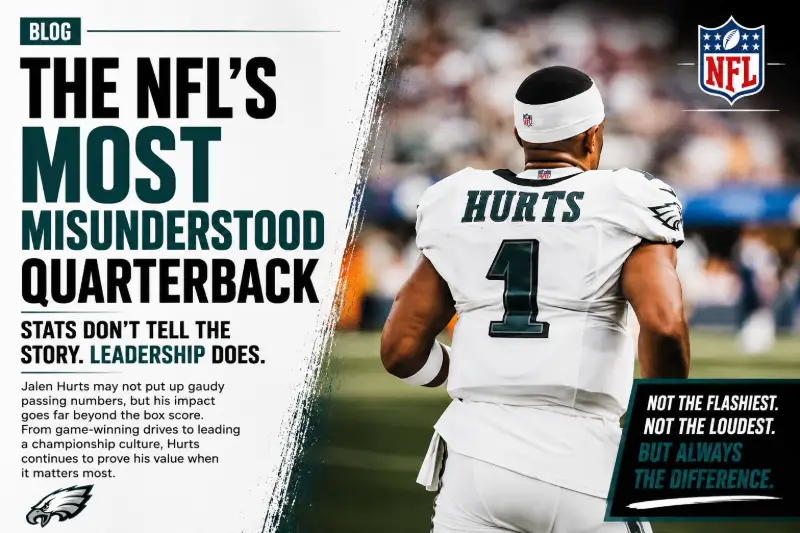
Every NFL offseason brings a new wave of quarterback rankings
Television networks, podcasts, social media personalities, and former players all attempt to answer the same question: Who are the best quarterbacks in football? The conversations almost always begin with statistics. Passing yards, touchdown totals, completion percentage, passer rating, and advanced analytics dominate the debate. Before long, quarterbacks are placed into tiers based almost entirely on production through the air.
It's an understandable way to evaluate the position, but it also raises an important question: what if we've been measuring quarterback greatness the wrong way?
No player illustrates that question better than Philadelphia Eagles quarterback Jalen Hurts
For years, Hurts has been one of the NFL's most accomplished yet consistently scrutinized quarterbacks. Critics often point to what he hasn't done instead of what he has. They'll remind you that he has never thrown for 5,000 yards in a season. They'll point out that he's unlikely to ever throw 50 touchdown passes. They'll compare his passing numbers to quarterbacks who operate in offenses designed to throw the ball 40 or 45 times every Sunday and use those comparisons as evidence that Hurts belongs a tier below the league's elite.
The problem isn't that those statistics are inaccurate. The problem is that they ignore the context surrounding how the Eagles play football.
Philadelphia has never asked Jalen Hurts to become a statistical phenomenon. They've asked him to become a championship quarterback.
Those are two very different jobs.
Building a Complete Football Team
Under General Manager Howie Roseman and Head Coach Nick Sirianni, the Eagles have built one of the NFL's most balanced and complete football teams. They've invested heavily in arguably the league's best offensive line, committed significant resources to the running game, surrounded Hurts with explosive weapons, and consistently fielded talented defenses. Their philosophy has never been centered around asking their quarterback to win games through volume passing alone. Instead, they've built a roster capable of controlling games in multiple ways.
Within that structure, Hurts has done exactly what the organization has asked of him. He has protected the football, extended drives with both his arm and legs, delivered in critical situations, and most importantly, won football games. Yet despite those accomplishments, conversations about his place among the league's elite quarterbacks continue to focus on what he isn't instead of appreciating everything he is.
Perhaps that's because some of the qualities that define great quarterbacks can't be measured by a statistic.
How We Started Measuring Quarterbacks Incorrectly
Football has always been the ultimate team sport, but somewhere over the past decade, quarterback conversations have become increasingly individual. Fantasy football, advanced analytics, and the rise of social media have created an environment where every performance is immediately reduced to numbers. Passing yards become talking points. Touchdown totals become arguments. Completion percentage becomes ammunition for debates that often ignore everything happening around the quarterback.
That's understandable to a point. Quarterbacks touch the football on nearly every offensive snap, and passing production remains one of the most important indicators of offensive success. However, the problem arises when statistics become the only lens through which greatness is evaluated.
Not every offense is designed the same way.
Some teams ask their quarterback to throw 700 passes a season because that's the identity of the offense. Others build around a dominant rushing attack, a physical offensive line, and complementary football. Comparing those quarterbacks without acknowledging the systems they operate in creates an incomplete picture.
The Eagles fall firmly into the second category.
Philadelphia doesn't enter games hoping Hurts throws for 400 yards. They enter games hoping their offensive line controls the line of scrimmage, their rushing attack wears down opposing defenses, and their quarterback makes winning decisions when opportunities present themselves. Hurts isn't asked to force throws into tight windows simply to inflate statistics. He's asked to manage the game, capitalize on explosive plays, and punish defenses that overcommit to stopping the run.
Ironically, that approach often suppresses the very statistics many people use to judge him.
If the Eagles rush for 200 yards and control possession for nearly 35 minutes, Hurts may finish with only 220 passing yards. To critics, that's an average statistical performance. Inside the Eagles' building, that's often considered outstanding quarterback play because he executed the game plan exactly as intended.
Winning organizations don't chase statistics. They chase victories.
That's an important distinction, and one that's often overlooked whenever Hurts enters national conversations about the league's best quarterbacks.
Leadership Doesn't Show Up on the Stat Sheet
If there is one quality that separates Jalen Hurts from many of his peers, it isn't arm strength or athleticism. It's leadership.
Leadership has become one of the most overused words in sports, often thrown around without much explanation. In Hurts' case, however, the term carries genuine meaning because it consistently appears in conversations with teammates, coaches, and members of the Eagles organization. Whether discussing offseason workouts, preparation habits, or the standard he sets inside the locker room, those closest to the team repeatedly point to Hurts as the emotional center of the franchise.
That influence cannot be measured by passing yards.
Leadership reveals itself in smaller moments. It appears when a quarterback accepts responsibility after a loss instead of assigning blame elsewhere. It appears during offseason workouts when veteran players voluntarily follow his example. It appears in late-game huddles when teammates remain calm because they believe the player calling the plays has complete confidence in the outcome.
Hurts has built that trust over time.
His journey has never been smooth. He experienced being benched in the national championship game at Alabama before reinventing himself at Oklahoma. He entered the NFL facing questions about whether he could become a franchise quarterback. Even after leading the Eagles to multiple deep playoff runs and Super Bowl appearances, doubts have continued to follow him.
Through every challenge, his response has remained remarkably consistent: He works. He improves. He leads.
The consistency of that approach has earned the respect of everyone inside the Eagles organization, and respect inside the locker room often carries far more weight than respect on television debate shows.
When the Lights Shine Brightest, Hurts Elevates His Game
Every quarterback can produce impressive statistics in September. The truly elite quarterbacks define themselves in January and February.
One of the most overlooked aspects of Jalen Hurts' career is that some of the finest performances he's ever delivered have come on football's biggest stage. While critics often point to regular-season passing numbers, they rarely acknowledge how Hurts has responded when championships are on the line.
That matters.
Pressure has a way of exposing weaknesses. Every throw carries greater significance. Every mistake is magnified. Every decision can alter the course of a season. Some quarterbacks become overwhelmed by those moments. Hurts has consistently embraced them.
In both of his Super Bowl appearances, he played with a level of poise and confidence that few quarterbacks ever display under those circumstances. Rather than shrinking beneath the weight of the moment, he elevated his play, demonstrating accuracy, toughness, and resilience against the NFL's best competition.
Those performances should carry significant weight when evaluating his career. After all, if the ultimate goal of every season is to win a championship, shouldn't a quarterback's biggest games matter more than another 350-yard passing performance in Week 6?
The Troy Aikman Comparison Is More Legitimate Than Many Realize
Whenever Jalen Hurts enters discussions about the NFL's elite quarterbacks, comparisons are usually made to today's pass-heavy stars. Patrick Mahomes, Joe Burrow, Josh Allen, Lamar Jackson, and others have redefined what quarterback production looks like in the modern era. While those comparisons are inevitable, they may not be the most appropriate way to evaluate Hurts.
A more fitting comparison might take us back three decades.
At first glance, comparing Hurts to Hall of Famer Troy Aikman may sound surprising. After all, Aikman played in a completely different era of football, and his career ended long before the spread offenses and pass-heavy philosophies that dominate today's NFL. However, when you look beyond the era and instead examine the role each quarterback played within his team's identity, the similarities become difficult to ignore.
The Dallas Cowboys of the 1990s weren't built around asking Troy Aikman to throw for 5,000 yards. They didn't need him to. They featured one of the greatest offensive lines in NFL history, a Hall of Fame running back in Emmitt Smith, elite playmakers on the outside, and a defense capable of controlling games. Aikman's responsibility wasn't to win games by himself. His responsibility was to maximize the talent around him, avoid costly mistakes, make timely throws, and elevate his play when championships were on the line.
That description sounds remarkably familiar.
Philadelphia has built its roster using many of the same principles. Howie Roseman has invested heavily in the offensive line because he believes championship football begins at the line of scrimmage. The Eagles have consistently prioritized the running game, surrounded Hurts with talented playmakers, and built defenses capable of keeping games under control. The expectation has never been for Hurts to throw the ball 45 times every week. The expectation has been for him to make the right decision, protect the football, and capitalize when opportunities arise.
Where the comparison stops, at least for now, is championships. Aikman retired with three Super Bowl victories and cemented his place among football's immortals. Hurts has already played in two Super Bowls and delivered outstanding performances on the game's biggest stage, but his legacy is still being written. Championships ultimately shape how history remembers quarterbacks, and Hurts knows there is still work to do before those comparisons can be fully embraced.
The Eagles Don't Need a 5,000-Yard Quarterback
One of the biggest misconceptions surrounding Jalen Hurts is the belief that his statistical ceiling somehow limits the Eagles' championship potential. In reality, Philadelphia's roster construction suggests the exact opposite.
General Manager Howie Roseman has never built the Eagles to rely exclusively on quarterback production. Instead, his philosophy has emphasized dominance in the trenches, roster depth, versatility, and complementary football. Every major investment over the past several seasons reinforces that vision. The offensive line remains one of the league's best. The running game continues to be a priority. The defense is expected to consistently keep games within reach. When all three phases are operating together, the quarterback doesn't have to throw for 400 yards to win.
That's by design.
Modern football has convinced many fans that elite quarterback play must always look the same. If a quarterback isn't putting up video game numbers every Sunday, he must somehow be falling short. The Eagles have rejected that philosophy entirely. Their goal isn't to win fantasy football championships. Their goal is to win Lombardi Trophies.
Hurts fits that philosophy perfectly. His ability to extend drives with his legs, convert critical short-yardage situations, protect the football, and make timely throws gives Philadelphia an offensive identity that is difficult to defend. Defenses can't simply focus on stopping the pass because Hurts' mobility changes the numbers in the running game. They can't overcommit to the run because Hurts has consistently shown the ability to make defenses pay through the air when opportunities present themselves.
Why the Goalposts Continue to Move
Perhaps the most frustrating aspect of evaluating Jalen Hurts is watching how quickly the standard changes. When the Eagles win, critics often point to the roster around him. If Saquon Barkley dominates a game, the conversation becomes about the running attack. If the offensive line controls the line of scrimmage, people argue Hurts is simply benefiting from elite protection. When the defense forces turnovers, his success is credited to complementary football.
Yet when the Eagles lose, the quarterback is suddenly expected to shoulder the blame.
It's a contradiction that few other elite quarterbacks consistently face.
The reality is that every championship quarterback has benefited from great coaching, talented teammates, and strong organizational support. Tom Brady had elite defenses and Hall of Fame coaching. Patrick Mahomes has Andy Reid, Travis Kelce, and consistently creative offensive schemes. Joe Montana played alongside Jerry Rice and one of the greatest coaches in NFL history. Troy Aikman was surrounded by Hall of Fame talent on both sides of the football.
Championships are rarely won by quarterbacks alone.
For some reason, however, Hurts is often expected to prove he can succeed without the very support systems every great quarterback has enjoyed. That's not a fair standard, and more importantly, it's not the standard history ultimately remembers.
How History Will Judge Jalen Hurts
Twenty years from now, fans won't spend much time debating whether Jalen Hurts threw for 4,100 yards or 4,600 yards in a particular season. They'll remember playoff victories. They'll remember championship appearances. They'll remember iconic moments.
History has a funny way of simplifying careers. Statistics eventually fade into the background while defining moments remain forever attached to a player's legacy. Joe Montana is remembered for four Super Bowl victories. Eli Manning is remembered for defeating the Patriots twice. John Elway is remembered for finally climbing the mountain after years of falling short. Those legacies were built in January and February, not during passing-yard races in October.
Hurts is creating that kind of resume. His greatest performances have consistently arrived when the stakes were highest, and that's not an accident. The qualities that make him successful; leadership, composure, resilience, and decision-making become even more valuable once the postseason begins.
If he ultimately brings multiple championships to Philadelphia, very few people will care whether he ever reached 5,000 passing yards. Winning changes every conversation. It always has.
Final Thoughts: Maybe We've Been Asking the Wrong Question
For years, football fans have asked whether Jalen Hurts belongs among the NFL's elite quarterbacks. Maybe that's the wrong question.
Perhaps the better question is this: Why are we measuring quarterback greatness almost exclusively through passing statistics when the ultimate objective has always been winning football games?
Hurts may never lead the league in passing yards. He may never throw 50 touchdown passes in a season. He may never produce the statistical resume that dominates fantasy football rankings or social media debates.
But the Eagles have never asked him to become that quarterback.
They've asked him to lead one of the NFL's premier organizations. They've asked him to set the standard inside the locker room, maximize one of the league's deepest rosters, perform when the pressure is greatest, and put the franchise in position to compete for championships every single season. By virtually every meaningful measure, he has answered that challenge.
Will he add more Lombardi Trophies to his resume? Time will determine that. Will he continue to face criticism despite winning football games? Probably.
That's the burden of playing quarterback in today's NFL.
Yet if history has taught us anything, it's that championships have a way of changing narratives. They reshape legacies. They silence critics. And they often force people to reevaluate everything they thought they knew.
Jalen Hurts doesn't need to become a 5,000-yard passer to cement his place in Eagles history. He simply needs to keep doing what he's done throughout his football career: Lead, Win, And let history decide the rest.