
This Week in the NBA: LeBron's Test, Luka's Hamstring, and a League on Tilt
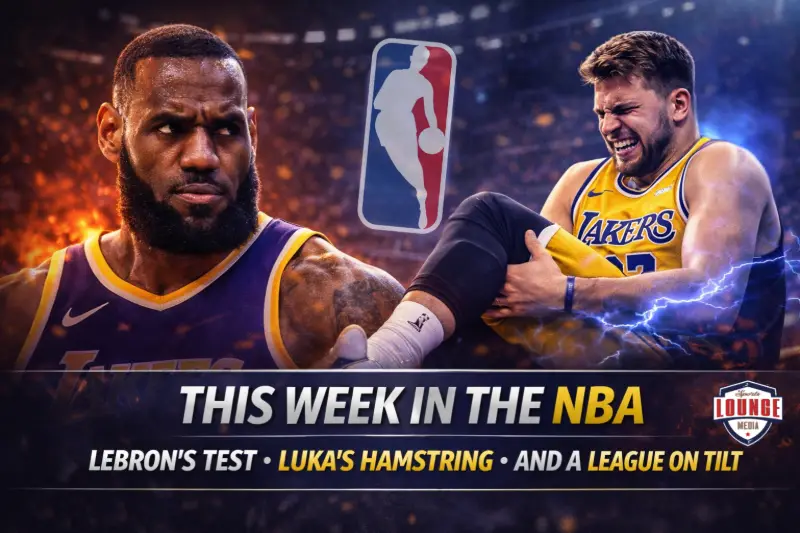
This week in the NBA feels like two different stories playing out at the same time. On one side, you have LeBron James and the Lakers trying to steady the ship with Luka Dončić and Austin Reaves both sidelined. On the other, you've got a league sprinting into the final days of the regular season, with seeding, awards, and even lottery odds still in motion.
If you're a Lakers fan, it's easy to lock in on the injury report and feel like the season is slipping away. But zoom out, and you'll see this is exactly the kind of chaos LeBron has learned to navigate better than almost anyone in NBA history. The question isn't just, "Can the Lakers survive without Luka and Reaves?" It's, "Can LeBron turn this wild final week into a setup for a deeper run?"
Luka's Hamstring and the Weight of Expectations
The headline that rocked Laker Nation: Luka Dončić is dealing with a Grade 2 left hamstring strain and will miss the rest of the regular season while he heads to Europe for specialized treatment.
The details matter here. A Grade 2 strain isn't a simple "tightness" situation you tape up and play through. It's a genuine soft-tissue injury, the kind that can linger or re-aggravate if you rush the timeline. That's why Luka's camp and the Lakers are aligned on a bigger picture plan: skip the regular-season grind, focus on getting that hamstring right, and aim to have him back in time for the playoffs rather than risking a setback just to chase seeding.
This is the tension that comes with modern superstar management. Luka is wired to hoop. His instinct is to push, to prove he can get back early, to shoulder the load for his team and protect his MVP and playoff narrative. But the organization has to think beyond the next seven days. You don't trade for a generational offensive engine just to burn him out chasing an extra home game in Round 1.
Basketball-wise, losing Luka this week rips the heart out of the Lakers' offensive identity. He's not just a scorer; he's a usage ecosystem. The playbook starts with him 30 feet from the basket, snaking through ball screens, manipulating weak-side help, and either getting to his step-back or feeding shooters and rollers. Take that out, and you're not just replacing a star, you're replacing a system.
Austin Reaves: The Underrated Loss That Changes Everything
If Luka's injury is the headline, Austin Reaves is the subplot that could quietly swing a series.
Reaves is out with a Grade 2 left oblique injury and expected to miss around four to six weeks. That means it's not just the rest of the regular season but his availability for early playoff rounds is very much in question. For a role player, that might sound minor. For the way this roster is built, it's huge.
Reaves is the classic "glue guard." He gives you on-ball creation when Luka sits, secondary playmaking when he's on the floor, and enough shooting to punish defenses that want to load up on the stars. He can initiate pick-and-roll, play off the catch, and slide between lineups without needing heavy touches to stay effective.
Without him, the Lakers lose:
- A reliable secondary ball-handler.
- A guard who can run offense in bench units.
- A tough, competitive defender who doesn't get hunted easily in switches.
- A guy who can close games next to stars without disruption.
In other words, it's not just losing stats; it's losing lineups. Certain combinations that worked all season suddenly don't have a natural connector. You start feeling that absence in the third quarter of must-win games when Luka is out, and LeBron sits for two minutes, and everything on offense looks like a struggle.
LeBron's New Assignment: Win Ugly, Win Smart
So what does LeBron do in the middle of this? The same thing he has done his entire career: adjust.
At this stage, LeBron isn't going to give you 40 a night across a two-month playoff run. But what he still does better than almost anyone is control a basketball game. Without Luka and Reaves, the path forward isn't LeBron trying to imitate 2013 Miami or 2016 Cleveland. It's LeBron turning games into slow, deliberate chess matches.
Here's what that looks like in practical terms:
1. Pace Control
Expect the Lakers to lean slower. Fewer transition shootouts, more half-court possessions. When you're down two guards, you don't want 105-possession games. You want 92-possession rock fights where every trip matters.
2. Matchup Hunting
LeBron will spend more possessions bringing weaker defenders into the action and dragging bigs into switches, forcing small guards to defend him in the post, and calling for screens until he gets the matchup he wants. That's how you manufacture efficient offense without a full playmaking cast.
3. Inverted Pick-and-Roll
Don't be surprised to see LeBron handling while bigger teammates set screens, then roll to punish smaller defenders who switch. When your guards are depleted, you flip the script and make your size an advantage.
4. Quarter-by-Quarter Management
LeBron understands flow. That might mean he spends the first quarter reading coverages, letting teammates get comfortable, then ramping up aggression in the third when defenses soften or mismatches appear.
Defensively, the Lakers still have a blueprint that works in a playoff context: protect the paint, use length on the wings, and trust LeBron as a roaming free safety. When he's locked in, he is one of the best in the league at calling out coverages, pre-rotating, and baiting ball-handlers into traps they don't see coming.
The key is buy-in. Role players have to accept that the margin is smaller now. Every screen has to be sharper. Every closeout has to be harder. Every cut has to have purpose. When a team is down stars, effort and detail become non-negotiable if you want to stay in the contender tier.
The Rest of the League: Final Week Frenzy
While the Lakers work through their own drama, the rest of the NBA is entering the most chaotic stretch of the season.
We're in the final week of the regular season. Twenty teams are locked into postseason basketball, but where they land in the bracket is still fluid. Standings in both conferences are tight enough that a single loss can swing a team from home-court advantage to a dangerous Play-In path.
In the East, the heavyweight at the top has already done its job. Detroit has secured the No. 1 seed and is using this week to tune up, rest strategically, and lock in rotations for Round 1. That's a luxury the middle of the conference doesn't have. Teams slotted between the middle seeds and the Play-In zone are still desperate to move up just one line to avoid a nightmare matchup or stay out of a sudden-death scenario.
In the West, it's less luxury and more knife fight.
Denver has come charging into this week on a hot streak, stacking wins and putting direct pressure on teams like the Lakers. With the records bunched up in that 3–5 range, even one off night can flip spots. The Nuggets' surge isn't just an interesting subplot; it directly affects how much margin for error LeBron has while he's short-handed.
Then there's Oklahoma City. The Thunder aren't just "ahead of schedule" anymore, they're here. With Shai Gilgeous-Alexander playing at an MVP level and OKC stacking statement wins throughout the year, they've blurred the line between "young up-and-comer" and "legit threat right now." When a team like that is breathing down your neck in the standings, every possession in this final week feels heavier.
The MVP Race Without Luka
Luka's injury doesn't just alter the Lakers' trajectory; it reshapes the MVP conversation.
For most of the season, Luka was sitting right near the top of that race with his numbers, his usage, and his impact on winning all fit the historic MVP template. But voters care about availability and how you close a season. With Luka sidelined during the final push, the door opens wider for guys like Jokic and Shai, especially if their teams keep climbing in the standings and stacking big performances in high-leverage games.
This is where narrative meets numbers. Voters will remember:
- Who showed up and dominated in seeding games down the stretch.
- Who played enough games to feel like their season wasn't fragmented.
- Who turned late-season chaos into stability for their team.
Luka's case doesn't evaporate, but it freezes, while others still have a week to build momentum. From a league-wide storytelling standpoint, his hamstring injury becomes one of those inflection points in a season where everything "what if" starts to live.
Tanking, Tune-ups, and the Other Side of the Standings
Not everyone is chasing seeding. Some franchises are quietly chasing ping-pong balls.
The final week is where "load management" for lottery teams becomes code for lineup experimentation, development minutes, and "evaluating young talent." You'll see big names scratched late, rotations full of rookies and two-way players, and a lot of lineups that will never see the floor again once this week ends.
There's a spectrum:
- True contenders at the top using this week to rest, refine sets, and scout likely opponents.
- Playoff locks in the middle trying to climb one more spot to avoid a bad matchup.
- Play-In teams treating every game like an elimination contest.
- Lottery teams quietly rooting for losses while framing it as opportunity for youth.
The league's drama isn't just at the top, it's in all those competing priorities intersecting at once.
Where This Leaves LeBron and the Lakers
Put all of this together, and you start to see just how big this week is for LeBron.
He's trying to:
- Hold onto favorable seeding without his two key backcourt partners.
- Keep the locker room belief high when the narrative outside is all doom and gloom.
- Manage his own body for a playoff run instead of burning everything just to survive the week.
If he can stabilize the team, avoid a slide into the Play-In mess, and walk into the postseason with Luka's hamstring trending in the right direction and Reaves on a realistic path back, this week will look very different in hindsight. It stops being "the week injuries ruined the season" and becomes "the week LeBron quietly held everything together while the rest of the NBA was spinning."
That's the kind of story that doesn't show up in the standings but lives in how we talk about legacy later.
The Bigger Picture
Every season has a moment where things either fracture or forge. For the Lakers, this might be that moment. For the league, this is the stretch where seeds, awards, and even future drafts get shaped.
LeBron doesn't have the luxury of viewing it as just another week. With Luka in Europe rehabbing and Reaves rehabbing his oblique, he's the constant, the stabilizer, the guy who has to make all the moving parts still feel like a plan.
And if history has shown us anything, it's this: counting him out in this kind of environment usually ages badly.